
Solving High-Rise Building Cleaning Challenges with Advanced Drone Technology
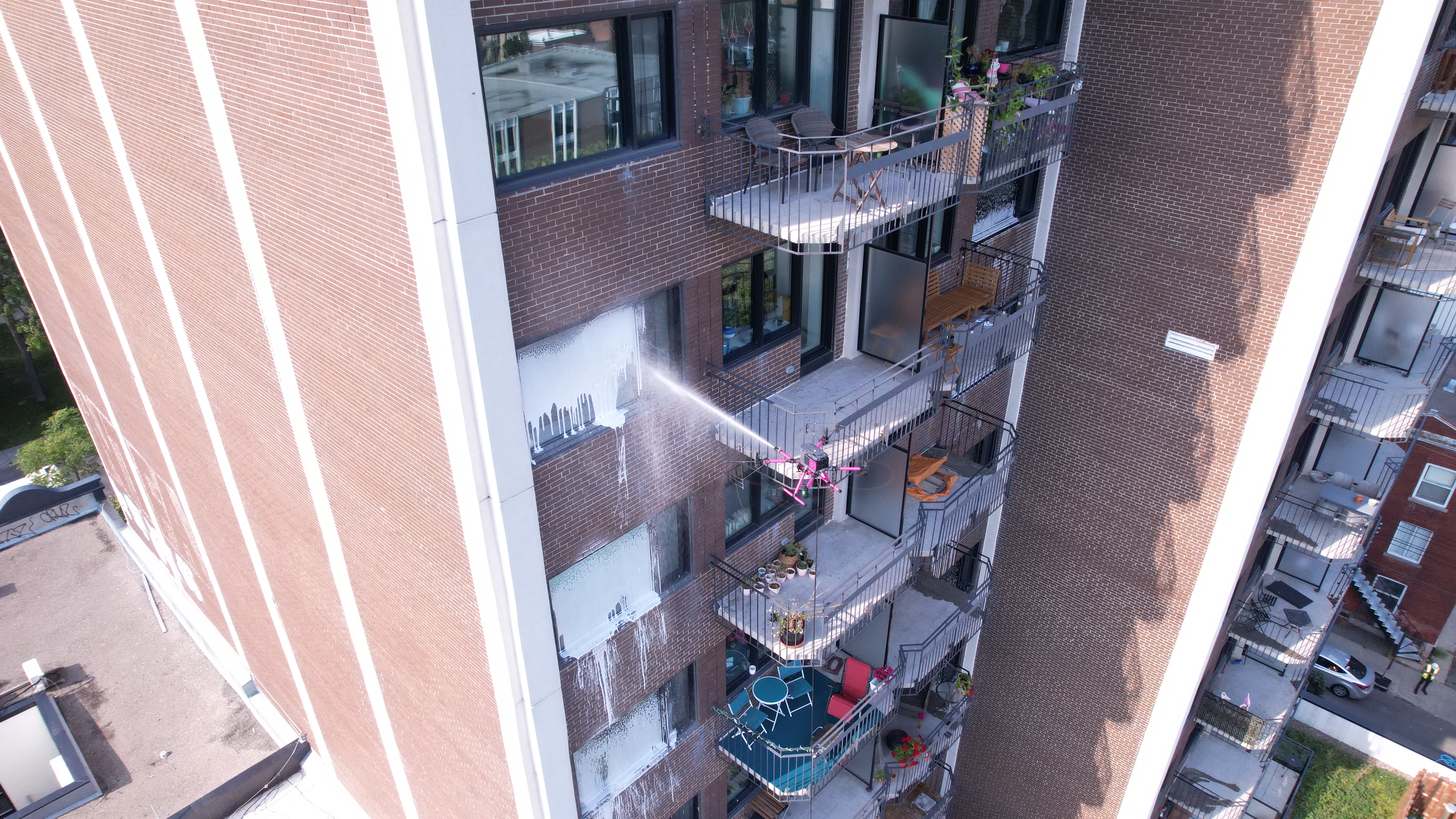
The Engineering Marvel: Drone Cleaning for Skyscrapers
High-rise buildings present a unique constellation of challenges that have historically made facade maintenance one of the most dangerous and expensive building operations. Structures exceeding 100 meters face wind conditions, accessibility constraints, and logistical complexities that push traditional cleaning methods to their limits—and often beyond safe operational parameters.
Advanced drone cleaning technology has emerged as a transformative solution, but successfully deploying these systems on tall buildings requires understanding and addressing the specific technical challenges these structures present. This comprehensive technical guide explores how modern drone cleaning systems overcome high-rise challenges through innovative engineering and operational approaches.
Understanding the High-Rise Environment
Aerodynamic Challenges
Tall buildings create their own microclimate, fundamentally altering wind patterns in ways that affect any aerial operations nearby.
Wind Acceleration:
As wind flows around a tall building, it accelerates at corners and edges due to the Venturi effect. Wind speeds can increase by 20-40% at building corners compared to ambient conditions. For a drone operating near the facade, this creates rapidly changing conditions that require sophisticated flight control responses.
Downdrafts and Updrafts:
Tall buildings create significant vertical air movements. The windward side of a building generates updrafts as air is forced upward, while the leeward side can create powerful downdrafts. These vertical air movements can exceed 5-10 m/s in moderate wind conditions, challenging any aircraft's ability to maintain stable hover.
Turbulence and Eddies:
The interaction of wind with building geometry creates turbulent zones, particularly near setbacks, balconies, and architectural features. These turbulent areas produce unpredictable, rapidly changing forces that traditional aircraft struggle to counteract.
Building Wake Effects:
The area behind a tall building (relative to wind direction) experiences highly turbulent, separated flow. Operations in this zone require pilots to recognize that conditions can change dramatically as they move around the building perimeter.
Structural and Accessibility Factors
Complex Geometry:
Modern high-rise architecture features setbacks, cantilevers, curved surfaces, and integrated mechanical equipment that create both visual obstructions and physical obstacles for cleaning operations. Traditional methods often cannot access recessed areas or areas beneath overhangs without specialized rigging.
Antenna and Equipment Installations:
Building tops frequently host telecommunications equipment, HVAC systems, window washing equipment, and other installations. These create both physical obstacles and, in the case of radio equipment, potential electromagnetic interference concerns.
Glass Curtain Wall Considerations:
Many tall buildings feature unitized glass curtain wall systems with specific cleaning requirements. Improper cleaning pressure or technique can damage seals, coatings, or the glass itself. Different facade zones may require different cleaning approaches.
Advanced Flight Control Technologies
Multi-Sensor Fusion
Modern drone cleaning systems employ sophisticated sensor fusion to maintain stable flight in challenging conditions:
GPS/GNSS Systems:
Multiple constellation receivers (GPS, GLONASS, Galileo, BeiDou) provide redundant positioning data. RTK (Real-Time Kinematic) or PPK (Post-Processed Kinematic) corrections achieve centimeter-level accuracy, essential for maintaining consistent distance from facades.
Inertial Measurement Units (IMUs):
High-frequency IMUs measure acceleration and rotation rates hundreds of times per second, enabling rapid response to disturbances. Advanced systems use redundant IMUs for fault tolerance.
Barometric Altimeters:
Precision pressure sensors provide altitude reference independent of GPS. Building-relative height can be maintained even when GPS signals are degraded by multipath reflection from nearby structures.
Visual Odometry:
Downward and forward-facing cameras track visual features to supplement GPS positioning. This technology is particularly valuable when operating close to reflective glass facades that can cause GPS multipath errors.
Ultrasonic and LIDAR Distance Sensing:
Short-range sensors provide precise distance measurement to the facade, enabling automatic maintenance of optimal cleaning distance regardless of wind-induced position variations.
Intelligent Flight Controllers
Disturbance Rejection:
Modern flight controllers use predictive algorithms to anticipate and counteract wind disturbances. Rather than simply reacting to position errors, advanced systems model building-induced wind effects and pre-compensate for expected conditions.
Attitude Rate Limiting:
To prevent aggressive corrections that could stress the aircraft or cause payload oscillation, controllers limit maximum rotation rates while still maintaining responsive handling.
Ground Effect Compensation:
When operating close to building surfaces, ground effect (increased lift from air compression between the drone and surface) can cause unexpected altitude changes. Advanced systems compensate for these effects.
Wind Resistance Capabilities
WINDOSMART and similar professional systems are rated for operation in wind conditions up to 35 km/h, but understanding these limits requires nuance:
Sustained vs. Gust Tolerance:
Rated wind limits typically refer to sustained wind speeds. Gust factors (momentary increases above sustained levels) must be considered. A building environment may have moderate average winds but severe gusts near corners.
Wind Direction Considerations:
Wind resistance varies by direction relative to the aircraft. Tailwinds can be particularly challenging as they reduce effective airspeed and control authority. Crosswinds create asymmetric loading.
Operational Decision Making:
Professional operators establish go/no-go criteria that account for forecast conditions, observed conditions at ground level, and estimated conditions at operating altitude. Conservative operators incorporate safety margins below rated limits.
Water Delivery System Engineering
Ground-Based Pump Systems
High-rise cleaning operations require substantial water flow rates at consistent pressure. Rather than carrying heavy pumps and reservoirs aloft, advanced systems use ground-based pumping with lightweight hose delivery:
High-Pressure Pump Specifications:
Professional systems use pumps capable of 100-200 bar operating pressure with flow rates of 10-20 liters per minute. Variable frequency drives enable precise pressure and flow control responsive to operator commands.
Pressure Loss Compensation:
As water flows through long vertical hose runs, friction and elevation create pressure losses. A 100-meter vertical rise creates approximately 10 bar of head loss before friction is considered. Ground pumps must compensate for these losses to deliver consistent pressure at the nozzle.
Flow Rate Management:
Cleaning effectiveness depends on achieving optimal water flow for the cleaning task. Too little flow produces poor cleaning; too much wastes water and can create runoff management issues. Smart pump controllers adjust output based on nozzle configuration and operator inputs.
Hose and Tether Systems
Lightweight Hose Design:
Purpose-designed cleaning hoses use high-strength synthetic materials to minimize weight while withstanding high pressures. Weight per meter is critical—each additional gram multiplied across 100+ meters significantly affects drone performance.
Hose Management:
Preventing hose tangles, snags, and excessive drag requires careful routing and management. Some systems use powered reel systems that maintain appropriate tension and prevent slack accumulation.
Tether Integration:
For operations requiring extended duration or maximum safety, tethered power systems eliminate battery limitations. Integrating power tethers with water hoses requires careful design to prevent interference.
Nozzle and Spray Technologies
Pressure-Optimized Nozzles:
Different facade materials require different cleaning pressures and spray patterns. Interchangeable nozzle systems allow optimization for glass, stone, metal panels, and other common facade materials.
Fan Spray Patterns:
Wide fan spray patterns cover more area per pass, improving productivity. Nozzle geometry is optimized for the standoff distance maintained by the drone's distance sensors.
Heated Water Options:
For cold-weather operations or particularly stubborn deposits, heated water significantly improves cleaning effectiveness. Inline heaters at the ground station warm water before delivery.
Operational Protocols for Tall Buildings
Pre-Operation Assessment
Site Survey:
Before first operations, comprehensive site surveys document building geometry, obstacle locations, access points, and potential hazard areas. Survey data informs flight planning and helps identify zones requiring special attention.
Wind Assessment:
Professional operators gather weather data from multiple sources: official forecasts, on-site anemometers at ground level and, if available, building-top weather stations. Wind direction relative to building orientation affects which facades can be safely cleaned.
Facade Material Identification:
Different facade materials require different cleaning approaches. Glass coatings, natural stone, EIFS (Exterior Insulation and Finish Systems), and metal panels each have specific pressure and chemical requirements.
Flight Planning
Sector-Based Approach:
Large facades are divided into manageable sectors for systematic cleaning. Sector boundaries are defined by architectural features, safe stopping points, and battery/water supply limitations.
Flight Path Optimization:
Efficient flight paths minimize non-productive transit time while ensuring complete coverage. Horizontal passes with vertical stepping are typically more efficient than vertical passes for most facade geometries.
Contingency Planning:
Each flight plan includes designated emergency landing zones, abort procedures, and wind limit criteria for mission termination.
Real-Time Operations
Pilot-Visual Observer Coordination:
High-rise operations often exceed the pilot's ability to directly observe the drone. Trained visual observers positioned at appropriate vantage points provide situational awareness and obstacle avoidance support.
Communication Protocols:
Clear, standardized communication between pilot, visual observers, and ground crew ensures coordinated response to changing conditions or emergencies.
Continuous Weather Monitoring:
Conditions can change rapidly, particularly in the building environment. Operators continuously monitor weather data and are prepared to abort operations if conditions approach limits.
Safety Systems and Redundancy
Flight System Redundancy
Dual Flight Controllers:
Critical systems employ redundant flight controllers with automatic failover. If the primary controller fails, the backup assumes control without operator intervention.
Motor Redundancy:
Multi-rotor configurations with more than four motors can maintain controlled flight even with single motor failure. Hex- and octocopter configurations provide this redundancy.
Power System Redundancy:
Dual battery systems or redundant power distribution prevent single-point electrical failures from causing loss of control.
Automated Safety Functions
Geofencing:
Virtual boundaries prevent the drone from entering prohibited areas (roads, neighboring properties, restricted airspace) even if pilot inputs would direct it there.
Return-to-Home:
Automatic return functions activate on low battery, loss of control link, or pilot command. RTH logic accounts for hose tether to prevent entanglement during automated returns.
Obstacle Detection:
Forward-facing and downward-facing sensors detect and avoid obstacles during flight. Advanced systems classify obstacles and adjust avoidance behavior accordingly.
Emergency Procedures
Loss of Control Link:
If the control link between pilot and aircraft is lost, predefined behaviors activate: hover in place, attempt to regain link, initiate RTH sequence.
Water System Failure:
If water pressure is lost or hose integrity is compromised, the cleaning operation is terminated and the aircraft is safely recovered.
Weather Abort:
When conditions exceed safe limits, established procedures ensure rapid, orderly recovery of the aircraft before conditions deteriorate further.
Case Study: 45-Story Commercial Tower
A recent deployment on a 180-meter commercial tower in a major metropolitan area illustrates advanced high-rise cleaning in practice:
Challenge: The building features a complex facade with setbacks at floors 15, 30, and the penthouse level. Traditional cleaning methods required extensive rigging changes at each setback, extending cleaning campaigns to 10+ days.
Solution: WINDOSMART drone cleaning addressed each facade section independently. The ground-based pump was positioned in a loading dock with hose routing through a service elevator shaft to minimize hose length.
Results:
- Complete exterior cleaning in 3 days vs. 10+ days traditional
- Zero safety incidents
- 55% cost reduction compared to previous year's traditional cleaning
- Building occupants reported minimal disruption compared to previous campaigns
Conclusion: The Future of High-Rise Maintenance
Drone cleaning technology has fundamentally changed what's possible in high-rise building maintenance. Challenges that once made tall building cleaning dangerous, expensive, and disruptive are now addressed through advanced engineering solutions.
The combination of sophisticated flight control, intelligent pump systems, and comprehensive safety measures enables single operators to accomplish what previously required large crews working at extreme heights. As these technologies continue to mature, we anticipate further improvements in capability, efficiency, and safety.
For building owners and facility managers responsible for tall structures, drone cleaning technology offers a compelling alternative to traditional methods—one that delivers better results at lower cost with dramatically reduced risk.
Ready to transform your building maintenance?
Discover how WINDOSMART drone cleaning systems can reduce costs, improve safety, and deliver superior results for your operations.
Request a quote